
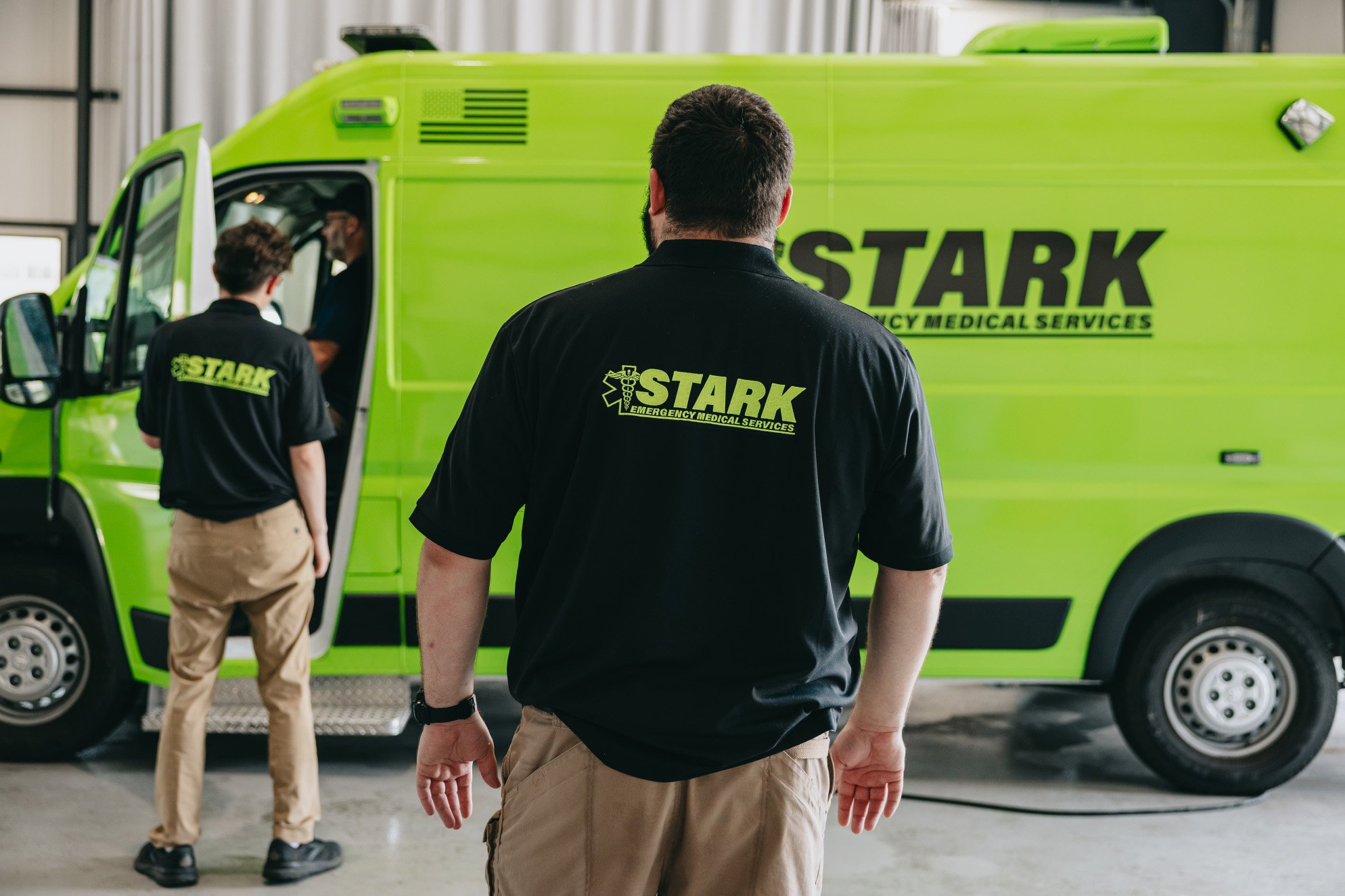
Most event organizers know they need medical coverage and have no framework for deciding how much, which is how events end up over- or under-covered.
Most people organizing an event know they are supposed to have medical coverage. Very few have any framework for deciding how much, which is how a county fair ends up with the same setup as a 5K and a demolition derby ends up with less than either.
Here is how to think about it before you make the call.
What does event EMS standby actually mean?
A crew and a unit assigned to your event for its duration — not dispatched to it, stationed at it.
That distinction is the entire point. A 9-1-1 response to an event has to travel, find an entrance, get through a crowd and locate the patient. An on-site crew is already inside the perimeter, already knows where things are, and is treating within a minute or two.
For most events the crew handles a lot of small things — heat, dehydration, minor injuries — and the value is that none of those become 9-1-1 calls that pull a unit away from the surrounding community.
How do I know what level of coverage my event needs?
Four questions get you most of the way:
How many people, and how concentrated? Two thousand spread across a fairground is different from two thousand in a grandstand.
What is the risk profile? Contact sports, motorsport, anything involving machinery, animals or height carries a different injury pattern than a craft fair.
Who is attending? An event heavy with older attendees or small children shifts the likely calls considerably.
What is the weather likely to be? A July afternoon in an open field generates heat cases in a way the same event in September does not. This is the single most underestimated factor at outdoor summer events in Illinois.
Does it matter how far away the nearest hospital is?
A great deal, and it is regularly overlooked at rural events.
An event twenty-five minutes from a receiving hospital has a materially different plan than one five minutes away. It affects whether on-site coverage should be able to hold and treat a patient rather than immediately transport, and whether one unit on site is enough — because the moment your only unit transports, your event has no coverage until it returns.
For events with any real distance to a hospital, the question is not just "is there an ambulance here" but "what happens to the event when that ambulance leaves."
What should coverage look like on the ground?
At minimum, a staffed unit with a clear, marked location that event staff and attendees can actually find. Signage matters more than people expect — a crew nobody can locate is not coverage.
Beyond that it scales: a shaded or sheltered treatment area for heat events, more than one crew for large or spread-out footprints, and roaming coverage on foot or by cart where a vehicle cannot reach quickly.
Worth agreeing in advance: where the crew stages, how event staff reach them, and where a unit exits if it has to transport. Sorting that out while an event is running is not the moment.
How far ahead should I book?
As early as you have a date. Summer weekends in Central Illinois are genuinely competitive — fair season, race season and festival season overlap, and the same weekends fill first every year.
Booking early also leaves time for the part that actually matters: a conversation about what your event involves. Standby that was scoped in a two-minute phone call is standby that was guessed at.
Who else needs to know about the plan?
Your local fire district, and often the county. Events sitting inside a contracted 9-1-1 district affect that district's coverage whether or not anyone tells them, and a quick heads-up avoids a lot of avoidable friction.
It also means that if something exceeds what is on site, the people responding already know what is there and where. We cover how that contracted coverage works here: The Six Fire Districts Stark County Answers For.
What if something serious happens?
The on-site crew treats, stabilizes and transports, and the event's coverage plan should already say what happens next — whether a second unit backfills, whether the event pauses, who makes that call.
If a patient is transported, the receiving hospital handoff works the same as any other transport. The information that speeds that up is the same too: What to Have Ready Before You Call for a Transport.
Related reading
- The Six Fire Districts Stark County Answers For — how contracted 9-1-1 coverage works across our districts, and why your event affects it.
- What to Have Ready Before You Call for a Transport — what a crew and a receiving facility need when a patient does have to go.
- Inside the Toulon Station: How a 9-1-1 Call Becomes a Response (coming soon) — what happens between the tones dropping and a unit arriving.
Planning an event in Central Illinois?
Stark County Ambulance covers events across eight stations in five Illinois counties — county fairs, races, festivals, school and community events from the Illinois Valley through the Peoria area to Champaign–Urbana.
Because we already run contracted 9-1-1 response in much of that footprint, we tend to know the venues, the access routes and the receiving hospitals before we arrive.
More on event EMS coverage, or get in touch to scope your event.