
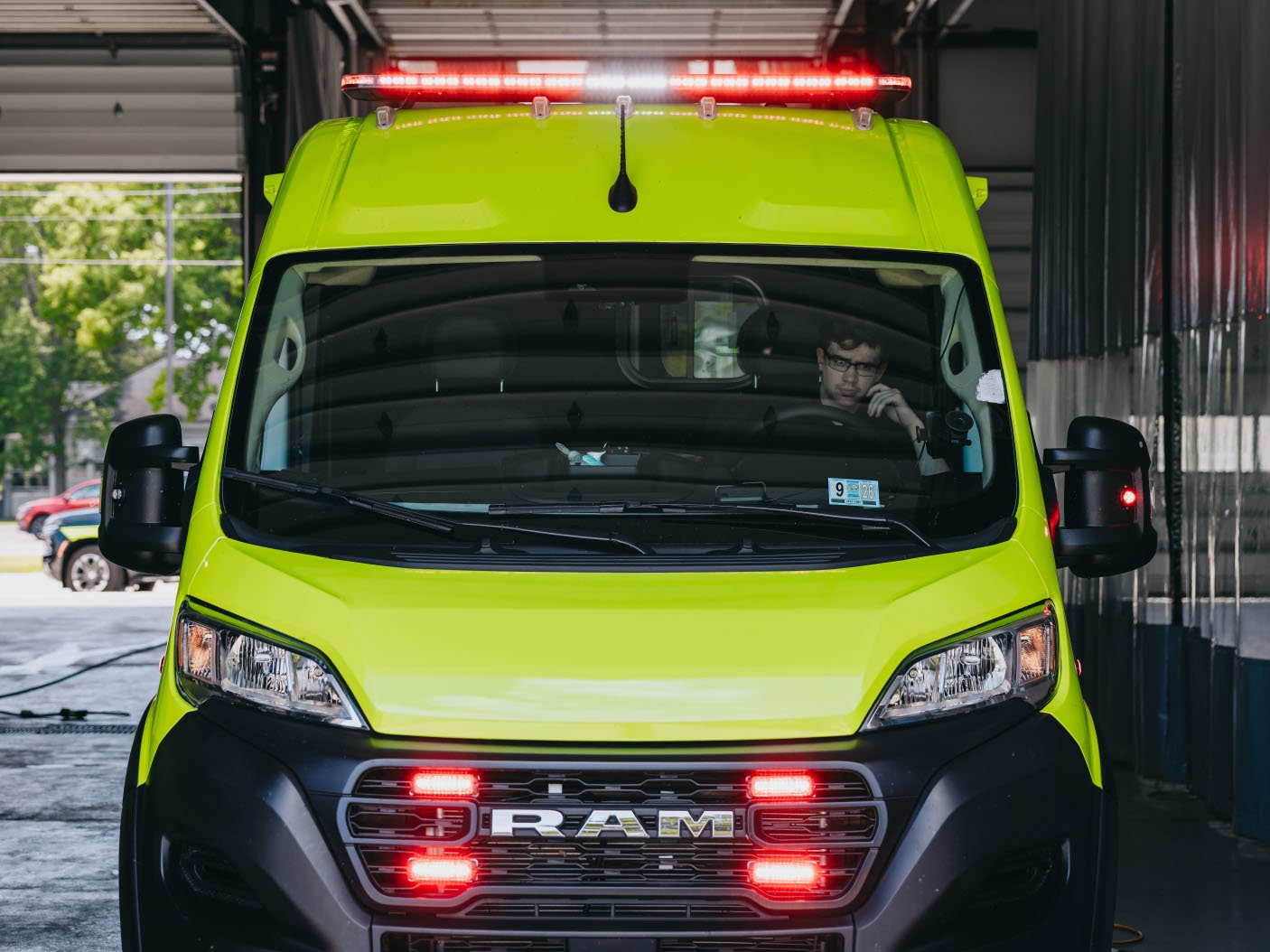
Our headquarters sits on Franklin Street in a town of about a thousand people, which tells you most of what you need to know about how we work.
Our headquarters is at 114 North Franklin Street in Toulon, a town of about a thousand people and the county seat of Stark County.
That is a slightly unusual place to put the head office of an ambulance service running eight stations across five counties. It is also completely deliberate, and it explains a fair amount about how the rest of it works.
Here is what actually happens between someone dialling 9-1-1 in this county and a crew walking through their door.
Where does a 9-1-1 call go first?
Not to us. It goes to the county dispatch center.
A dispatcher takes the call, establishes location and nature, and determines which agencies need to respond. For a medical emergency in the Toulon fire protection district, that means an ambulance from us — and frequently the fire district as well, depending on what has happened.
The caller is often still on the line while the tones drop. Dispatch does not wait for the full story before starting a crew moving; they gather the rest while we are already en route.
What happens at the station?
The tones come in over the radio and the crew moves. Destination, nature of the call, and anything dispatch has learned so far comes across on the way to the truck and continues over the radio once they are rolling.
One detail people find surprising: much of the useful information arrives after the ambulance is moving. There is no version of this where a crew stands in the bay assembling a complete picture first. You go, and you learn on the way.
Who is on the ambulance?
Illinois-licensed EMTs and paramedics. On a 9-1-1 response in this district you are getting paramedic-level care — advanced airway management, cardiac monitoring, IV access, and medications that can be given in the field rather than waiting for a hospital.
That matters more in a rural county than an urban one. In a town with a hospital ten minutes away, the argument for advanced care in the field is real but modest. When the nearest appropriate receiving facility is a substantial drive, the treatment that begins in your living room is a much larger share of the care you get in the first hour.
What does the crew do when they arrive?
Assess first. What happened, what is happening now, what is likely to happen next.
Then treat what needs treating on scene, and decide — with the patient, where the patient is able to take part in that — whether transport is needed and where to. Not every call ends in a trip to hospital. A significant share are people who needed assessment and reassurance more than they needed an emergency department.
If transport is happening, the crew packages the patient, gets them into the ambulance, and continues care the whole way. "Continues care" is doing real work in that sentence. The back of a moving ambulance is a clinical environment, not a waiting room with wheels.
Where do patients from Stark County go?
Wherever is appropriate to the condition, which around here usually means the Peoria area, Galesburg or Kewanee.
The destination is not automatic and it is not always the closest hospital. Cardiac, stroke and trauma cases may need a facility with a specific capability, and going to a nearer hospital that then has to transfer the patient again is worse for the patient than going further the first time.
Crews make that call with dispatch, with medical direction, and with what they are seeing in front of them.
Why is the headquarters in a town this small?
Because the coverage model only works if the units are actually in the communities.
It would be simpler to run everything from one central base in a larger town. It would also make every call in Stark County longer, and in rural EMS the drive is the single biggest variable in how a call goes. A unit stationed in Toulon is not dispatched toward Toulon. It is already there.
The same logic put stations in Bradford, Wyoming and Galva, which together with Toulon cover the six fire districts we answer for. More on that arrangement here: The Six Fire Districts Stark County Answers For.
Does the same station handle transfers between hospitals?
The organisation does, and that is a deliberate part of the design.
Interfacility transport runs alongside 9-1-1 coverage. It is what supports the fleet, the licensing and the staffing depth that around-the-clock emergency coverage depends on — funded across a wider base of work than emergency calls in a county of six thousand people could sustain on their own.
A service that only ran 9-1-1 in a county this size would be a much more fragile thing.
What is genuinely different about rural response?
Distance, and what it does to everything else.
Longer drives to patients. Longer drives to hospitals. Fewer units within reach when a second call comes in. Addresses that a GPS gets approximately right and a crew who has worked the county for years gets exactly right.
It also means the crew is more likely to know the patient. In a county this size that is not a sentimental observation — it is clinically useful. Knowing that someone does not usually present this way is real information, and no chart contains it.
What should I do if I need to call?
Call 9-1-1. Do not call the station directly and do not drive yourself if something might be serious.
When you call: your address first, then what is happening. Stay on the line — the dispatcher is often giving instructions that matter before we arrive, and answering their questions does not slow anything down. The crew is already moving.
If someone can safely meet the ambulance outside or turn a porch light on, do that. On a rural road at night it saves more time than it sounds like.
Related reading
- The Six Fire Districts Stark County Answers For — who we cover, and how contracted 9-1-1 works in rural Illinois.
- What to Expect When a Family Member Is Transported — what happens when a patient moves between hospitals.
Interested in working out of a station like this one?
The Toulon station is our headquarters and one of eight across five Illinois counties. Crews here run contracted 9-1-1 response and interfacility transport, which is a broader mix of work than most services this size offer.
We hire IDPH-licensed EMTs and paramedics and pay for continuing education. See current openings.